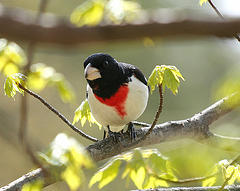
 A new yard bird today! I don’t keep a written yard list, but am happy to add a new one to the *list* anyway! Lots of people get grosbeaks at their feeders, but what a surprise it was for me to pull into the driveway from work and see this guy feeding on stray sunflower seeds beneath the feeders. I’ve never even spotted them in the neighborhood before, but guess I could easily have missed them because their song is so similar to a Robin’s. I called my husband on the cell phone and told him to come to the kitchen window to see it. I woke him from a nap, but he was excited to see it anyway. I love spring migration and its many surprises! I didn’t have a chance to take a pic, but found this pretty one on flickr.com originally uploaded by RicKarr.
“The evening was calm and beautiful, the sky sparkled with stars. Suddenly there burst on my soul the serenade of the Rose-breasted bird, so rich, so mellow, so loud in the stillness of the night, that sleep fled from my eyelids. Never did I enjoy music more.” – John James Audubon quoted in For the Birds: An Uncommon Guide by Laura Erickson.
Erickson describes the grosbeak’s song as “like a Robin who takes voice lessons. [The song] is a long, rich warble. Robins sing long sentences, the words often three syllables – Rose breasted Grosbeak sentences can’t be broken into distinct words as easily.” For the Birds 5-29
In Bird Lore (1901) Emily B. Pellet describes the grosbeak’s song as a musical, “You’re a pretty bird. Where are you?” I think of it like a Robin’s, but in a deeper, more tenor voice and listen for its sharp “kick” call note.
Category Archives: Uncategorized
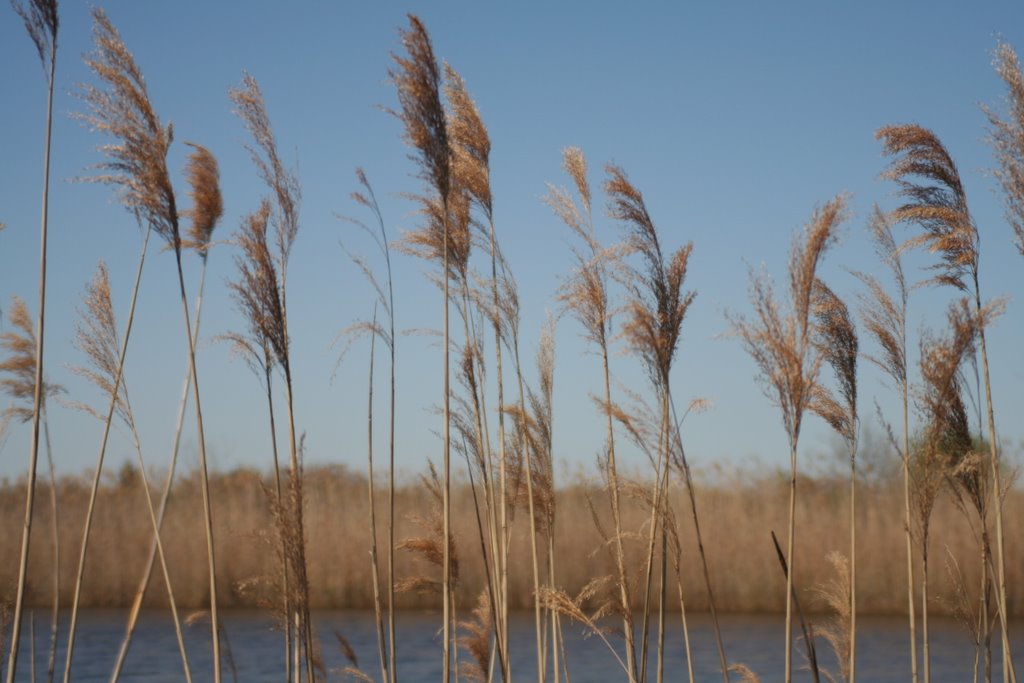
Phragmites at North Pond
 The air is like a butterfly
With frail blue wings.
The happy earth looks at the sky
And sings.
– Joyce Kilmer, Spring
Photo of mom for Mother’s Day
 My brother calls this a *cheesecake* shot. I don’t know when or where it was taken, but love this pic of my mom long before she was a mother. She loved the beach so I imagine this was taken with the ocean or a lake nearby.
I was a little kid when my mom passed away and never had the chance to know her as anything other than my *mommy*. Sad really, when I see the friendships that my girlfriends have with their moms now that we’ve grown up. I rely on my brothers and old photos like this for glimpses into the person she was.
People tell me I look like her and my dad always said I had some of her mannerisms – one thing I know is that I could never look as good in a bathing suit!
NJ Audubon World Series of Birding
 Great Egrets and Black-Crowned Night Herons at Plum Island
I love World Series Day! I’ve been participating with the Century Run team for Sandy Hook Bird Observatory for a number of years and always have a good time. The last few years I haven’t been able to bird the whole day because of other things going on, but in my experience the hours from dawn until noon are the best, anyway. It was very foggy and damp when we started out at 5:30 this morning, but the weather had cleared by noon when I left and it turned out to be a beautiful day.
The following is the trip report sent via email by the team leaders and a few pics from the day.
 SHBO Century Run Team at Plum Island
“The SHBO Sandy Hook Century Run today tallied 131 species between 5:30 am and 8:30 pm; much better than we anticipated given the rather weak migration this week and the dominance of easterly winds. Our day started off with a nice shorebird flight over Plum Island with 200+ Least Sandpipers, dozens of Black-bellied Plovers, Semipalmated Plovers, Greater Yellowlegs & Short-billed Dowitchers, 4 Lesser Yellowlegs, and 8+ Solitary Sandpipers. Our only Little Blue Heron, Black Skimmers, and Black-billed Cuckoo of the day were here also.
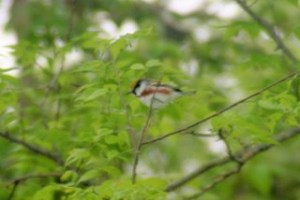
Chestnut-Sided Warbler
The Locust Grove was quite active with passerines today, highlights including a calling Alder Flycatcher, Yellow-throated Vireo, numerous warblers with a female Bay-breasted being the standout. A vocal Least Bittern was calling from the east end of North Pond. Lots of diurnal migrants overhead with flocks of Eastern Kingbirds and Blue Jays predominating.
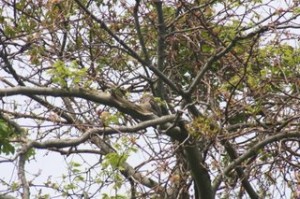 Dare ya to find the snoozing Nighthawk!
The Raccoon Alley area had a perched and oblivious Common Nighthawk, 6+ Blue-headed Vireos, Yellow-throated Vireo, Warbling Vireo (scarce migrant at the hook), Blackburnian Warbler, and Canada Warbler.
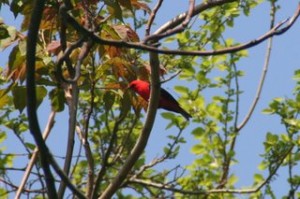 Scarlet Tanager
Saltmarsh Sharp-tailed Sparrows must have been migrating today: we saw 4-6 in the spartina marsh at Plum Island and there was another individual in the thick upland grass adjacent to k-lot. 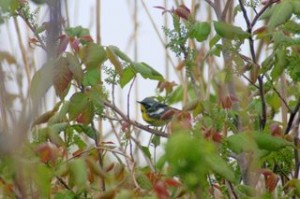
Magnolia Warbler in Poison Ivy. My favorite pic of the day.
After comparing notes at dusk and getting a sneak peak at the “Sandy Hook Platform Onlies” bird list, we have a preliminary total of 150 species for the hook today, including 23 species of warbler and a fly-by Mississippi Kite that passed the migration watch around 4:30 this afternoon.”
Final standings and more info on the World Series is available here.
International Migratory Bird Day
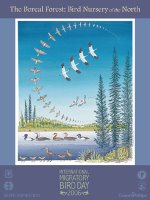 I missed a story on the way home from work on NPR about International Migratory Bird Day, but checked their website this evening and found a lot of wonderful links there. I’ve only been listening to NPR (WNYC 93.9) for the last year or so and wonder why I didn’t start listening sooner. Love them! Their website is great, too. A wonderful diversion for a few hours if you have the time. The link to today’s story and other interesting bird-related links can be found here.
The image at left is this year’s poster by Radeaux and celebrates the theme of the boreal forest as the “bird nursery of the north”. Click on the image for more info.
I’ll be out tomorrow doing the “World Series of Birding” with Sandy Hook Bird Observatory. The weather doesn’t look too promising, but hopefully we’ll get plenty of birds. We’re meeting at 5:30 a.m. and will bird until dark. I doubt that I’ll last that long, but we’ll see!
Another book to look for
 A dear childhood friend passed along a recommendation for this new book written by one of his colleagues at Bank Street College in Brooklyn. It sounds like a relevant read for anyone who is a caregiver or is concerned with the issues of aging parents. Another one to look for on my next stop at the bookstore.
I wish that I had done some reading last year when I was caring for my dad. I’d imagine that many of the difficulties we faced are commonplace to families adapting to a parent who can suddenly no longer live independently due to illness. I also like to keep a list of books that make helpful gifts for friends facing difficult times. Once I’ve read this one, I may pass it along to a friend or two in need.
Another of the rose kin
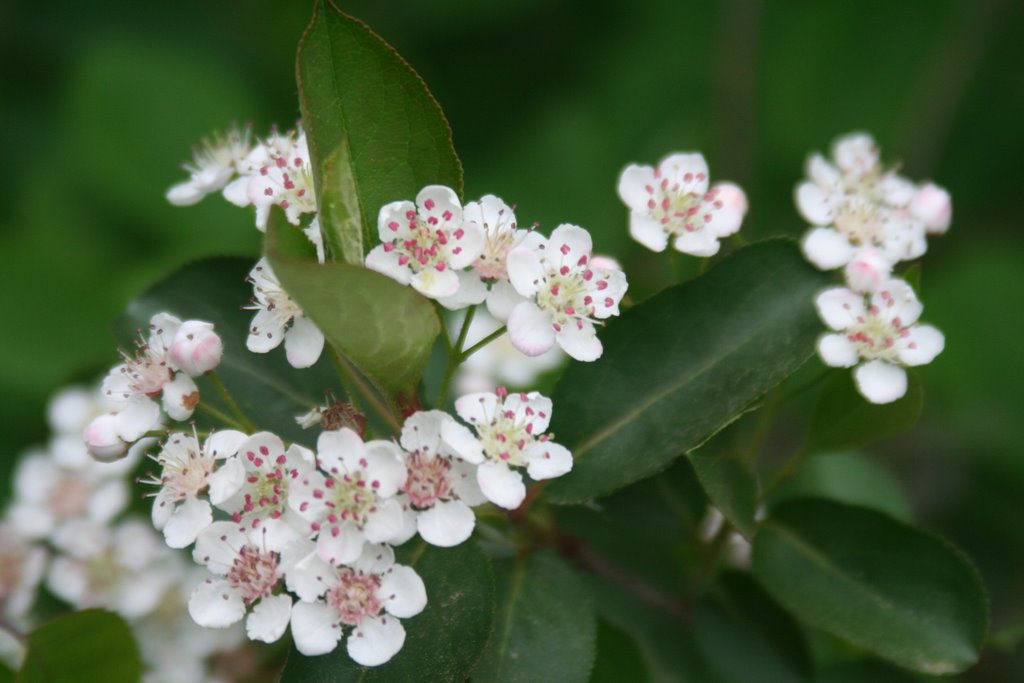 The black chokeberries (Aronia melanocarpa) are blooming beside the pond this week; the red variety is said to be attractive to birds, but the black certainly is not. Last year’s dried up berries remain on the plant, uneaten. The small, pinkish-white flowers have the characteristic 5 petals of the rose family.
More views from Sandy Hook
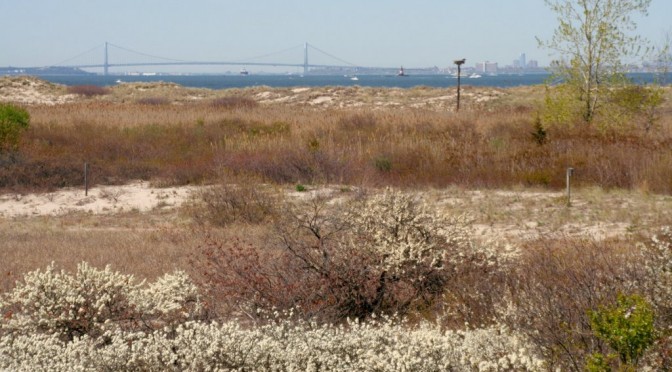
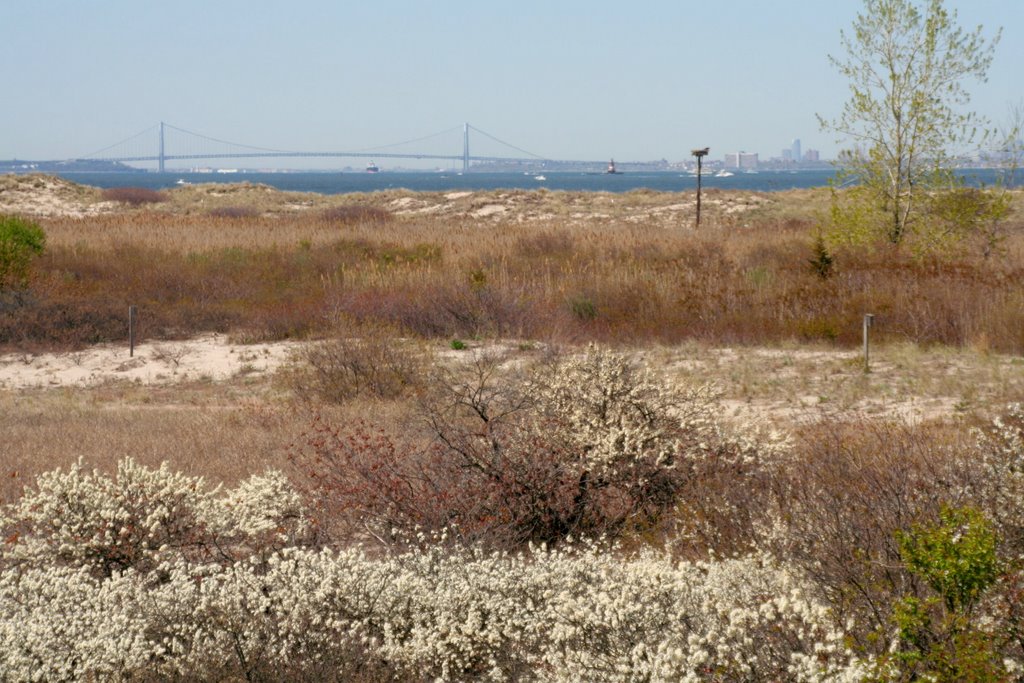 I just can’t seem to get enough beach plum pics – the dunes at North Pond are covered with it. Poison ivy grows like mad out there too and is just starting to green up some in this view from below the hawk watch platform. In the near distance is an occupied osprey platform and behind that is the Verranzano Bridge which connects Brooklyn and the rest of NYC to Staten Island.
Today was my volunteer day at the Sandy Hook Bird Observatory; lots of people around, but few birds from what I heard. Quite a few of the visitors today were new birders who I love to talk with – their enthusiasm is great and spring migration is a perfect time to pick up binoculars for the first time.
Somehow I forgot to bring my camera with me today, so I missed the chance to photograph the white-crowned sparrows and the hummingbirds that are coming to the center’s feeders. Chipping sparrows have been moving through my yard, but I haven’t seen a white-crowned yet. I’ve also had my hummingbird feeder out for a few weeks at home, but haven’t had any, yet. For some reason, I can’t seem to attract them until mid-July.
Here’s another shot of the Yellow Warbler from Friday. I heard one of these singing this afternoon, but he was hidden in the foliage of a hackberry tree.
Yellow Warbler
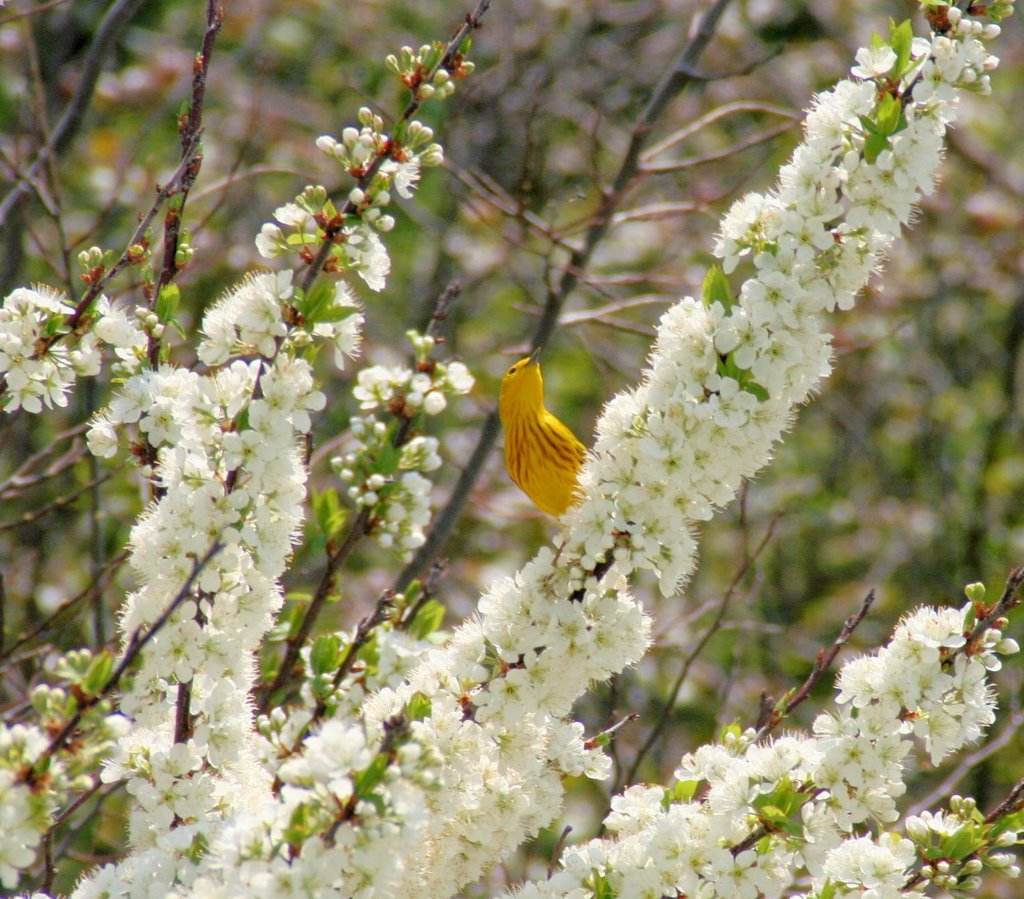 Yellow Warbler and Beach Plum
Yellow Warblers are a common wood warbler that can easily be heard singing from woodland edges and marshy, wet areas. They nest along the small stream that borders the farm fields up the street. Their song is easy to recognize; I learned it as, “Sweet, sweet, sweet, I’m so sweet!” I spent a few hours today at Sandy Hook looking for migrants that the winds had brought our way. I found many beautiful birds, but none were so cooperative as this little one who was busy feeding on the flying insects attracted to the blooming beach plum. He was even nice enough to pause and show off the reddish streaks on his breast.
Singing lessons (for Linda)
 My ears are much better than my eyes at identifying birds. My distance vision is not good and I’m too vain to wear my eyeglasses other than when I’m driving. I find glasses especially uncomfortable with binoculars. Because I have trouble spotting the movement of birds, I’ve come to rely on my ears more than my eyes and have tried over the years to develop my knowledge of bird songs. It’s a handy skill to have (and a good way to impress non-birding friends) and is easy to do if you’re an auditory person like me. I’ve always learned best by listening and in school was often reprimanded for *daydreaming*, when in fact I was paying close attention with my ears rather than my eyes.
In the sprin g I like to *warm-up* my ears to warbler song by listening to birdsong cd’s. This way I avoid the frustration of hearing birds that I can’t see while still knowing who’s out there singing. I like to play the cd’s at bedtime and usually fall asleep to their sweet seranade. I also make a *cheat sheet* that I carry with me when birding to help me distinguish between certain birds that I have trouble with. My favorites are the “Peterson’s Birding by Ear” and “Peterson’s More Birding by Ear”.
My friend Linda at work wants to learn about birds and I’ve offered to bring her along on a spring walk. She’s dissuaded by the early hour and suggests we have brunch, then bird, and finish up with some shopping. We have a running joke where she *sings* a bird song that she heard that morning to me and I’m supposed to tell her what it is that she heard. Somehow all of her *songs* sound the same. This morning she saw a cardinal and I tried to teach her its song as “Tear-tear-tear.” With her Brooklyn accent it turned into something unrecognizable, but we’ll keep working on it.
A LISTENER’S GUIDE TO THE BIRDS by E.B. White
Wouldst thou know the lark?
Then hark!
Each natural bird
Must be seen and heard.
The lark’s “Tee-ee” is a tinkling entreaty.
But it’s not always “Tee-ee” –
Sometimes it’s “Tee-titi.”
So watch yourself.
Birds have their love-and-mating song,
Their warning cry, their hating song;
Some have a night song, some a day song,
A lilt, a tilt, a come-what-may song;
Birds have their careless bough and teeter song
And, of course, their Roger Tory Peter song.
The studious ovenbird (pale pinkish legs)
Calls, “Teacher, teacher, teacher!”
The chestnut-sided warbler begs
To see Miss Beecher.
“I wish to see Miss Beecher.”
(Sometimes interpreted as “Please please please ta
meetcha.”)
The redwing (frequents swamps and marshes)
Gurgles, “Konk-la-ree,”
Eliciting from the wood duck
The exclamation “Jeeee!”
(But that’s the male wood duck, remember.
If it’s his wife you seek,
Wait till you hear a distressed “Whoo-eek!”)
Nothing is simpler than telling a barn owl from a veery:
One says, “Kschh!” in a voice that is eerie,
The other says, “Vee-ur” in a manner that is breezy.
(I told you it was easy.)
On the other hand, distinguishing between the veery
And the olive-backed thrush
Is another matter. It couldn’t be worse.
The thrush’s song is similar to the veery’s,
Only it’s in reverse.
Let us suppose you hear a bird say, “Fitz-bew,”
The things you can be sure of are two:
First, the bird is an alder flycatcher (Empidonax traillii
traillii);
Second, you are standing in Ohio – or as some people
call it, O-hee-o-
Because, although it may come as a surprise to you,
The alder flycatcher, in New York or New England,
does not say, “Fitz-bew,”
It says, “Wee-be-o.”
“Chu-chu-chu” is the note of the harrier,
Copied of course, from our common carrier.
The osprey, thanks to a lucky fluke,
Avoids “Chu-chu” and cries, “Chewk, chewk!”
So there’s no difficulty there.
The chickadee likes to pronounce his name;
It’s extremely helpful and adds to his fame.
But in spring you can get the heebie-jeebies
Untangling chickadees from phoebes.
The chickadee, when he’s all afire,
Whistles, “Fee-bee,” to express his desire.
He should be arrested and thrown in jail
For impersonating another male.
(There’s a way you can tell which bird is which,
But just the same, it’s a nasty switch.)
Our gay deceiver may fancy-free be
But he never does fool a female phoebe.
Oh, sweet the random sounds of birds!
The old-squaw, practising his thirds;
The distant bittern, driving stakes,
The lonely loon on haunted lakes;
The white-throat’s pure and tenuous thread-
They go to my heart, they go to my head.
How hard it is to find the words
With which to sing the praise of birds!
Yet birds, when they get singing praises,
Don’t lack for words – they know some daisies:
“Fitz-bew,”
“Konk-la-reeee,”
“Hip-three-cheers,”
“Onk-a-lik, ow-owdle-ow,”
“Cheedle, cheedle chew,”
And dozens of other inspired phrases.
Got that, Linda?
😉